
Hotels invest heavily in winning the room booking. Revenue teams manage rates, marketing teams generate demand, and distribution teams work to improve conversion. But once the reservation is confirmed, the commercial effort often slows down.
That is where many hotels begin leaving revenue on the table.
A strong hotel revenue growth strategy should treat the confirmed booking as the beginning of the commercial relationship, not the end. The guest has chosen the property, but many purchasing decisions are still ahead. These may include a room upgrade, airport transfer, dining, spa treatments, tours, attraction tickets and other experiences outside the hotel.
The objective is not to push more products. It is to make the stay easier and more complete. Good upselling should feel like service, not selling.
The Booking Begins the Commercial Relationship
Hotels often treat the booking confirmation as an operational handover. The reservation enters the property management system, and attention moves to room allocation, check-in and service delivery.
Commercially, that is too narrow.
The period between booking and arrival is one of the hotel’s strongest opportunities. The guest is planning the trip and is actively making decisions. A well-timed offer for an airport transfer can remove uncertainty. A relevant room upgrade can improve the stay. A dining or spa reservation can make the arrival experience more convenient.
If the hotel remains silent, the guest does not stop planning. The guest simply looks elsewhere.
Hotels Focus Too Narrowly on What They Operate
Many hotels understand the value of promoting their own restaurant, spa and other facilities after the guest arrives. Keeping more spending within the property is commercially sensible.
The mistake is assuming that this is the full opportunity.
Almost every leisure guest will also want to experience the destination outside the hotel. They may book sightseeing tours, attraction tickets, private guides, transport, restaurants or other activities. A hotel may prefer guests to spend more time on the property, but it cannot ignore how travellers actually behave.
Guests will book external experiences. The real question is whether they book them through the hotel or through another channel.
When the hotel does not provide a trusted and convenient option, online travel platforms, street agents and other intermediaries capture the booking, the customer relationship and the margin.
External Experiences Need Product Knowledge
One reason hotels overlook external experiences is that their teams often have limited knowledge of the available products. They may know the main attractions, but not which operators are reliable, which experiences suit different guest segments, how bookings should be confirmed, or what happens when plans change.
This knowledge gap makes hotel teams cautious. Recommending an internal spa treatment feels safe because the hotel controls delivery. Recommending an external tour can appear riskier because another company will represent the property in front of the guest.
That concern is valid. The answer is not to ignore external products. It is to select the right local partner and build clear standards around quality, communication, pricing, availability and problem resolution.
This is where destination development consulting can help hospitality businesses turn local experiences into a structured guest proposition rather than an informal collection of brochures at the concierge desk.
A Partnership Must Feel Like Part of the Hotel
I have seen hotels benefit significantly from strategic partnerships with local tour companies that manage tours, transfers and attraction tickets on their behalf.
However, putting a tour desk in the lobby is not enough.
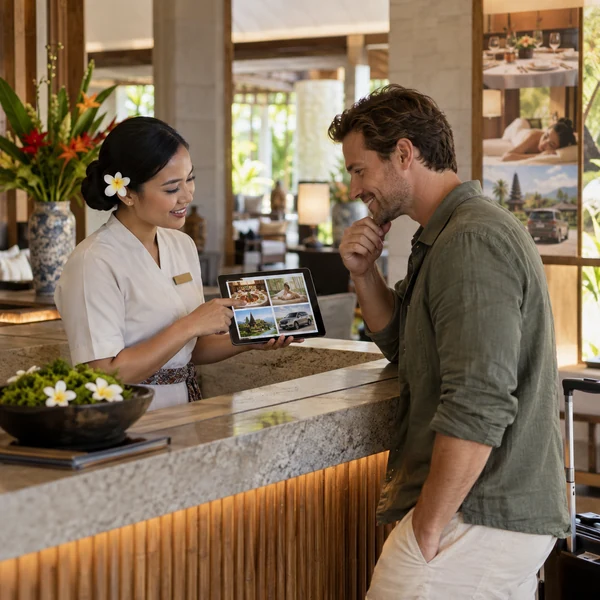
For the partnership to work, the external service must feel like an integrated part of the hotel experience. The guest should encounter it throughout the journey, starting with the welcome email and continuing through pre-arrival communication, the hotel website or app, in-room television screens and well-placed QR codes.
The booking process must also be simple. Availability should be clear, confirmation should be fast, payment should be convenient, and the hotel team should know who is responsible when a guest needs help.
Without this integration, guests will still book. They will simply book through someone else.
Upselling Is Not the Front Desk’s Responsibility
A common management mistake is treating upselling as mainly a front-desk responsibility. Staff are asked to mention room upgrades, breakfast or spa treatments during check-in, and management then measures whether they sold enough.
By that point, much of the opportunity has already passed.
A guest arriving after a long flight may want the room key, not a sales presentation. Many decisions should have been supported earlier, when the guest was still planning the trip and had time to consider the options.
Hotel upselling therefore needs coordination across revenue management, reservations, marketing, operations, front office, food and beverage, concierge and external partners. Someone must own the overall commercial journey, but every relevant department must understand its role.
Revenue culture is not created by telling one department to sell more. It is created by building a system in which relevant offers are easy to present, easy to purchase and safe to deliver.
Technology Follows Commercial Design
Technology and AI are becoming increasingly important in this process. A structured AI strategy and implementation approach can help hotels use guest information to make offers more relevant, automate communication, display live availability and make products bookable through links, apps, televisions and QR codes.
But technology should not be the starting point.
The hotel must first map the guest journey, select the right products, identify the responsible teams, define the commercial terms and agree how each service will be fulfilled. Technology can then scale that structure.
The same applies when selecting a local tour partner. The partner should not only understand the destination and deliver reliable service. It should also be capable of providing its own booking technology or integrating useful product and availability data into the hotel’s systems.
Automating a weak commercial model does not make it stronger. The inputs to technology must come from the operational decisions made by management, reservations, marketing and the frontline teams.
What Hotels Should Do First
The first step is to map the complete guest journey from confirmation to departure. Management should identify when the guest is likely to make each decision and which communication channel is most appropriate at that moment.
The second step is to select a limited number of relevant, reliable offers. These should include the strongest internal products as well as external services that guests are already likely to purchase.
The third step is to assign ownership. Pricing, margin, availability, communication, booking, fulfilment and problem resolution must be clear before an offer is promoted.
The fourth step is to prepare the teams. Reservations, marketing, front office and concierge need practical product knowledge and simple guidance on which offers suit which guests.
Only then should the hotel automate the process. Technology can improve timing, consistency and conversion, but it cannot decide what the hotel should sell or compensate for weak products and unclear responsibilities.
Good Upselling Feels Like Service
The strongest hotel upselling strategies do not feel like a series of sales messages. They feel like the hotel understands what the guest may need.
The right suggestion arrives at a useful moment. The product is relevant. The booking is easy. Delivery is reliable. If something changes, the guest knows where to get help.
That is why the commercial opportunity after booking should not be reduced to selling a higher room category at reception. It covers the entire stay and extends beyond the hotel itself.
Hotels already spend heavily to acquire the guest. A better hotel revenue growth strategy captures more value from that relationship while improving the experience. The booking begins the commercial relationship, and good upselling makes that relationship more useful to both the guest and the hotel.